
Below you can find the latest updates to our learning resources. We recommend checking this section regularly to stay informed of any changes. Updates may arise from:
• Revisions to the exam syllabus
• Amendments to the relevant CII study texts that directly impact our materials
• Corrections to typographical errors
• Adjustments addressing more complex issues
By reviewing these updates, you can ensure your study materials remain accurate and aligned with current requirements. Simply click onto the Study Material required and any updates will display below.
Please note: The Categories for the filters will only appear if there are posts within that category. If a category doesn’t have any posts within it, it wont display to users.
Keeping your study materials up to date is essential for exam success.
To ensure you are working with the most accurate resources, we recommend checking this page regularly. Here you will find updates that directly affect your study materials, helping you stay aligned with the latest requirements
Updates to your study materials are published directly on the CII website at www.cii.co.uk. To locate them, select your exam unit and look for the “Unit Updates” section displayed in the right‑hand column. We recommend reviewing both the “Learning Solutions Update” and “Qualification Update” headings to ensure you are working with the most current information.
Chapter 3.2.4 / page 58
The Benefits relating to mortgages or rental costs summary table has been corrected to the attached.
Activity 1.4 FSCS claims – (ii) James and Mary.
The ‘joint’ section has been updated to include both the home insurance policy and the mortgage, as well as the cash.
Question 74: Stefan is purchasing a residential property to add to his property portfolio. The purchase price is £150,000 and he will achieve rental income of £560 per month. He should be aware that…
The SDLT calculation in the rationale was incorrect. This did not affect the correct answer to the question, but to clarify the correct SDLT for Stefan would be:
First SDLT £125,000 at 5%: £125,000 × 5% = £6,250
Remaining SDLT £25,000 at 7%: £25,000 × 7% = £1,750
Total SDLT payable: £6,250 + £1,750 = £8,000
Q190 has been rephrased as follows: Kathy, a higher rate taxpayer is completing her tax return online. All her earned income is taxed by PAYE and she has also received some income distributions from her range of OEICs. Her UK equity fund paid her distributions of £5,750 and her high-yield corporate bond fund distributions totalled £1,050. How much income tax is payable to HMRC on these distributions assuming these are all of Kathy’s savings and investments?
Section 1.4.4 – SDLT
A section has been added to this chapter regarding the SDLT paid by companies:
SDLT applies to both individuals and non-natural entities including companies.
In most cases, the higher rates of SDLT (as shown below) apply to companies under the following circumstances:
The SDLT rates applicable to companies, based on the value of the property, are as follows:
| Purchase Price /Lease Premium / Transfer Value | Resident Corporate Bodies | Non-Resident Corporate Bodies |
| Up to £125,000 | 5% | 7% |
| £125,001 to £250,000 | 7% | 9% |
| £250,001 to £925,000 | 10% | 12% |
| £925,001 to £1.5 million | 15% | 17% |
| Over £1.5 million | 17% | 19% |
Example 1.23
There was a type in example 1.23 however the totals were all correct. The correct wording should be:
1.23
Charles and Robert have exchanged properties. Neither are first-time buyers.
They are trying to save on costs such as agent fees and SDLT.
Robert’s property, which Charles bought, was worth £550,000 and Charles’ property, which Robert bought, was worth £552,000. How much SDLT will they save?
Charles £0 – £125,000 x 0% = £0
£125,001 – £250,000 x 2% = £2,500
£250,001 – £550,000 x 5% = £15,000
Total Stamp Duty Land Tax = £17,500
Robert £0 – £125,000 x 0% = £0
£125,001 – £250,000 x 2% = £2,500
£250,001 – £552,000 x 5% = £15,100
Total Stamp Duty Land Tax = £17,600
Overall total: £17,500 + £17,600 = £35,100
There will be no SDLT saving, as stamp duties cannot be avoided by exchanging properties. It will still be charged on the current market value of each property.
End of chapter question 19 – Peter, a higher rate taxpayer, has £90,000 of savings in his only building society account. Karen, an additional rate taxpayer, has £101,000 in her only bank deposit account. Both accounts provide the same interest rate. In comparing the two accounts you would note…
Answers C and D were both marked as correct in error. The only correct answer is D.
D. Karen’s account is less likely to provide voting rights.
Question 1
The new FSCS limit is £120,000 rather than £85,000.
We have therefore amended answer B to £245,000 which is the correct answer (answer C was previously highlighted as correct.
The revised rationale is:
The FSCS covers 100% of a deposit where the provider has become insolvent per person per marketing group, capped at £120,000.
Therefore, Paul and Alex’s joint account of £150,000 is entirely covered since they each would be protected for up to £120,000 on the accounts with Bank X. The £45,000 not used up by the joint account can be used by Paul for his sole account. In addition, Alex would have up to £120,000 protection with Bank Z so his sole account of £50,000 is covered in its entirety. So £75,000 +£75,000 + £45,000 + £50,000 = £245,000.
Chapter 1.2.7
In the table labelled Venture Capital Trust, we incorrectly stated that the tax reducer rate was 30%. The correct figure is 20%. This has now been corrected as follows:
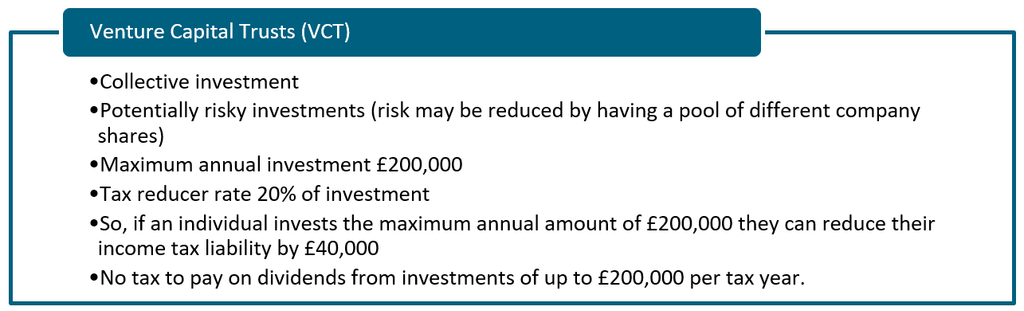
Question 176: Roger and Chastity were married and both were UK residents. Roger was of UK domicile but Chastity is of Belgium domicile. When Roger died earlier this year, his £1,050,000 estate, including the mortgage-free family home, was inherited by Chastity. How much inheritance tax, if any, was due?
This question has been re-written to reflect the new residency rules. The re-worded question now reads: Roger and Chastity were married. Roger was a UK long term resident but Chastity was from Belgium and was not a UK long term resident. When Roger died earlier this year, his £1,050,000 estate, including the mortgage-free family home, was inherited by Chastity. How much inheritance tax, if any, was due?
Question 35: Brian and Rhianna are married and have one daughter, Heather. Brian is a UK long term resident and Rhianna a Brazilian resident and not UK long term resident. Brian has died, leaving an estate of £850,000, including the mortgage-free family home valued at £600,000. What inheritance tax (IHT) liability will there be on his death if everything passes to Rhianna?
The correct answer is C – £80,000
Clarification: the £175,000 Residence Nil‑Rate Band (RNRB)is only applicable to Brian’s direct descendants (children / grandchildren) therefore Rhianna would not be able to use this even though the entire estate has been passed to her. We had previously calculated the answer with Rhianna being eligible to use this benefit which was incorrect.
The question has been amended to state that Brian and Rhianna had a daughter to avoid any further confusion.
The correct answer therefore is £850,000 – £325,000 NRB – £325,000 (for non-UK LTR spouse) = £200,000 x 40% = £80,000 (answer C).
Question 124: Chris and Jessica invested £20,000 into a joint onshore life assurance bond just over 8 years ago. They are considering surrendering the bond for £28,000 having taken no withdrawals. If Chris is a higher rate taxpayer and Jessica a basic rate taxpayer, how will any gain be assessed for income tax purposes?
The question previously stated that Chris and Jessica both invested £20,000 which would have meant that there was no gain to be assessed (£20,000 + £20,000 – £28,000 = -£12,000). Chris and Jessica actually invested £20,000 between them so there is a gain of £28,000 – £20,000 = £8,000.
Chapter 2.2.3: Class 1 Contributions – employers
The table showing the rates of secondary Class 1 NICs as shown in the R03 tax tables were incorrect. The correct rates are attached.
Section 1.2.4 – Charity contributions made via Gift Aid
The study guide originally stated the following: The charity must be established in the UK, or in another EU member state, or in Norway or Iceland. The charity itself can only recover the 20% basic rate amount, regardless of the tax position of the donor
Since Brexit, this is no longer correct. We have changed the study guide to read the following:
To claim Gift Aid, the charity must be recognised by HMRC for tax purposes. The charity can reclaim the basic-rate tax element of a donation, currently worth 25p for every £1 donated. Any additional tax relief due to higher-rate or additional-rate taxpayers must be claimed by the donor and cannot be reclaimed by the charity
Answer C was marked as correct in error.
The correct answer should have been D. repayment of any excessive pension contributions made.
Question 41
Question text: Jeff, Simon and Marty have the following DC pension schemes respectively:
£44,000 section 32 buyout bond with guaranteed minimum pension
Which of the following statements are TRUE in relation to transferring these benefits?
£32,000 retirement annuity contract with a guaranteed annuity rate
£38,000 personal pension plan with protected tax free cash
Answers B and C were both marked as correct however the correct answers are C and D:
C: Jeff and Marty require independent advice prior to transfer.
D: All three members have protected / guaranteed benefits within their schemes.
Question 10
Question text: Naz has a personal pension of £800,000, a section 32 guaranteed minimum policy of £220,000 and an retirement annuity contract of £100,000. How much pension commencement lump sum (PCLS) could Naz take in the current tax year?
Answer D was incorrectly written as £22,5000. It should have been £225,000.
Q39 – Carol partially retired in July 2025, crystallising some of her defined contribution pension benefits into flexi-access drawdown from which she has been making withdrawals. Carol has been contributing £2,500 monthly to a personal pension plan for the last fifteen years. She now wishes to make an additional £15,000 single gross premium into this plan. What rules apply to her use of carry forward of the annual allowance (AA) and money purchase annual allowance (MPAA)?
The question has been modified to clarify exactly what is required.
Answer A is now correct: Carry forward in relation to both the AA and MPAA cannot be used by Carol.
